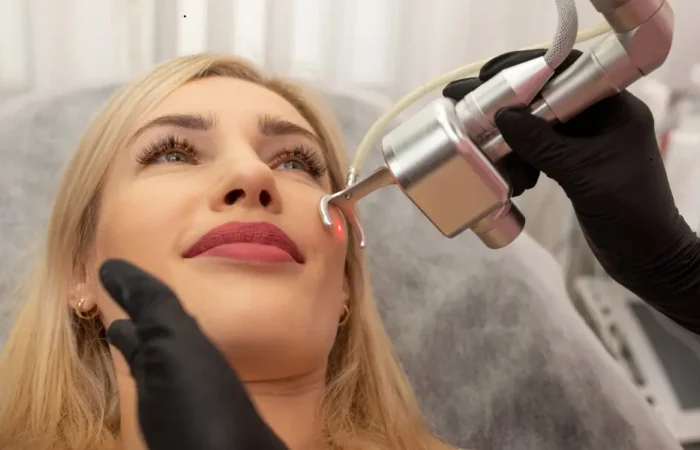
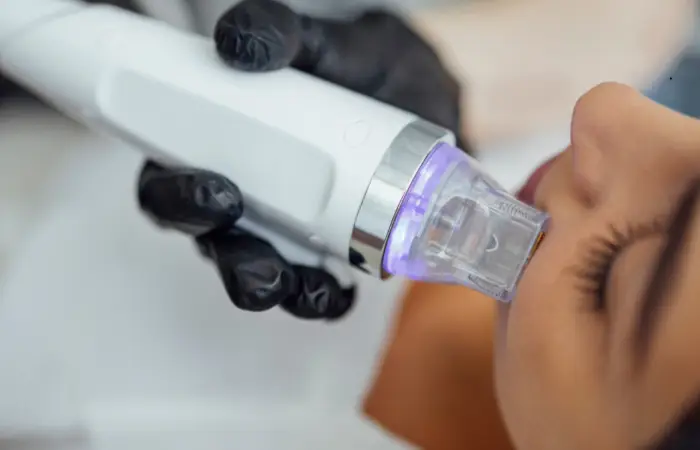
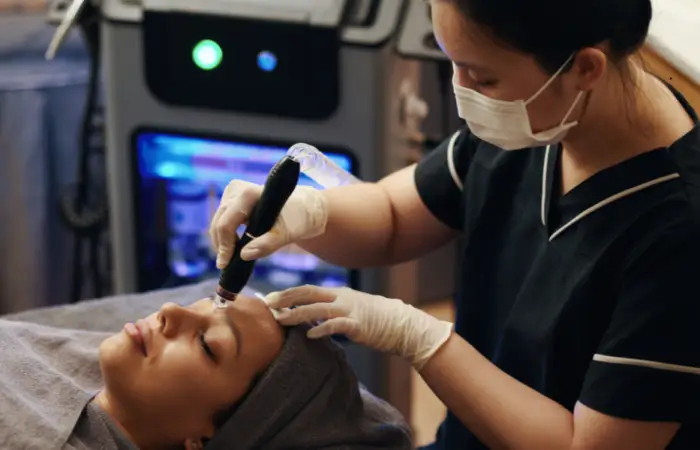
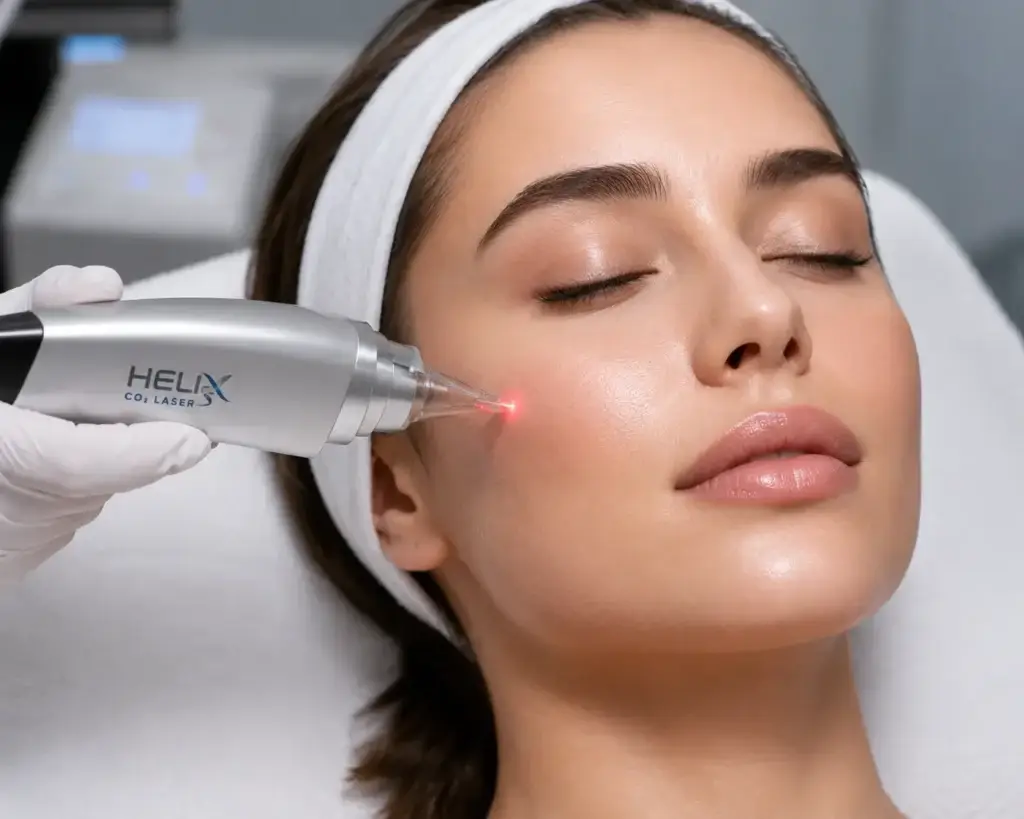
The Helix CO2 laser is an advanced skin resurfacing device built by Candela, a company with a long track record in medical laser technology. It uses fractional carbon dioxide energy, which means the laser treats the skin in a precise grid of microscopic zones rather than removing the entire surface. The untreated skin between those zones acts as a reservoir of healthy cells that speeds recovery.
What makes the Helix system stand out is its flexibility. The same device can deliver treatments that range from a gentle, no-downtime refresh to a deeper resurfacing session for more advanced concerns. Our providers tailor each session to your skin and your goals, adjusting the laser’s depth and intensity, which is why two clients sitting in our treatment room can have very different experiences with the same laser.
How fractional CO2 energy works
Carbon dioxide lasers work at a wavelength that is strongly absorbed by water in the skin. When the beam reaches the tissue, it converts to heat, vaporizes a narrow column of skin cells, and warms the area surrounding it. That controlled injury is the point. It signals the body to launch a wound-healing response, and that response is where the results come from.
Two processes follow. First, the outer layer of skin sheds and is replaced by fresh, smoother tissue. Second, the heat delivered deeper in the skin stimulates fibroblasts, the cells responsible for producing collagen and elastin. Over the following weeks and months, new collagen builds, and the skin becomes firmer and more even. Because the Helix laser works fractionally, it triggers this renewal while leaving enough healthy tissue intact to keep recovery short. That balance between renewal and recovery is the core advantage of the technology, and it is what allows us to offer real resurfacing without asking clients to step away from their lives for two weeks.
WA short history of CO2 laser resurfacing
Carbon dioxide laser resurfacing has been part of dermatology since the 1990s, when fully ablative CO2 lasers set a new standard for treating wrinkles and scars. The results could be striking, but the treatments removed the entire top layer of skin, and recovery often stretched across two weeks or more.
The turning point came in 2004, when researchers Dieter Manstein and R. Rox Anderson at Massachusetts General Hospital introduced the concept of fractional photothermolysis. Their idea was to treat the skin in tiny, evenly spaced columns rather than all at once. This approach preserved islands of healthy tissue and cut recovery time sharply while lowering the risk of complications. Fractional CO2 lasers followed, and the Helix system represents a modern, refined version of that lineage, pairing fractional delivery with treatment modes that suit a wider range of skin types and schedules.
The concerns we treat with the Helix laser
We use the Helix CO2 laser to address a range of skin concerns, including:
- Fine lines and wrinkles, particularly around the eyes and mouth
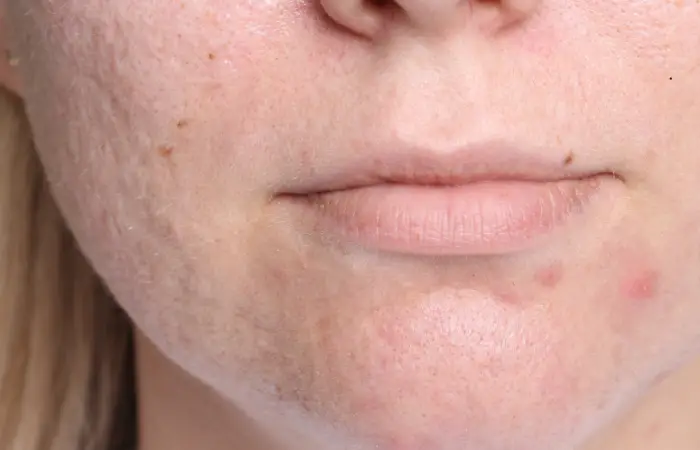
- Acne scars and certain surgical scars
- Sun damage, age spots, and uneven pigmentation
- Enlarged pores and rough or dull texture
- Mild skin laxity and loss of firmness
Many clients come to us with more than one of these concerns at the same time, and that is exactly where this laser is at its best. Because we can adjust its settings, a single treatment plan can target several issues together.
The three Helix treatment modes
One of the reasons we invested in the Helix system is its range. The device offers distinct treatment modes, and during your consultation we help you choose the one that fits your goals and the recovery time you can spare. The table below outlines how they compare.
| Mode | What it does | Downtime | Best for |
| CoolPeel | Light ablative resurfacing of the skin’s surface layer | Little to none | A quick refresh for fine lines and early sun damage |
| Sultra | Non-ablative energy at a 1570 nm wavelength that heats deeper layers without breaking the surface | Minimal | Gradual collagen building, and a safer option for darker skin tones |
| Fusion | Blends ablative and non-ablative energy in one session to treat several depths at once | Roughly 2 to 5 days of light peeling | More advanced concerns such as deeper wrinkles, acne scarring, and laxity |
What the research shows
Fractional CO2 laser technology has been studied extensively, and the evidence behind it is one of the reasons we feel confident recommending it. Research consistently shows meaningful improvement in skin texture and scarring after fractional CO2 treatment, with results that tend to hold over time.
| Research insight: A systematic review of clinical studies on fractional CO2 laser therapy for acne scars found that most patients experienced a 30 to 70 percent improvement in the appearance of their scars. |
Results vary from person to person, and factors such as skin type, the specific concern, the number of sessions, and your aftercare all influence the outcome. This is one reason we always begin with a consultation rather than a fixed package. Even so, the strength of the clinical record behind fractional CO2 resurfacing is a meaningful point in its favor.
What a Helix treatment looks like with us
We keep the experience straightforward and comfortable from start to finish.
Your visit begins with a consultation, where one of our providers examines your skin and talks through your goals before explaining which treatment mode makes sense for you. If you are weighing CO2 lasers against other options, this is also a good moment to raise that. We cover the comparison in our article on CO2 laser versus microneedling, which many clients find helpful before they decide.
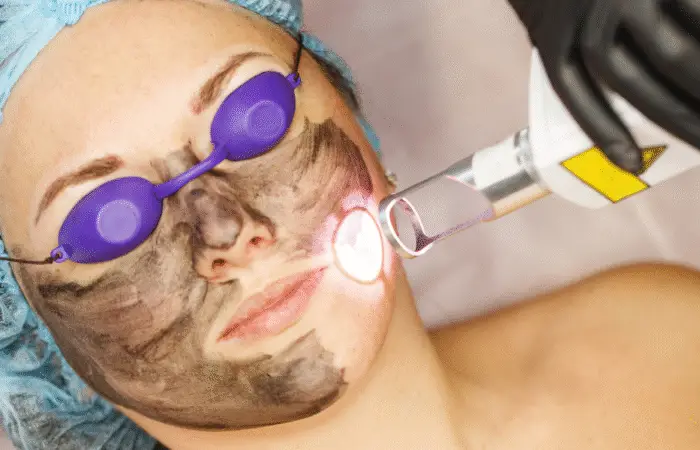
On the day of treatment, we apply a topical numbing cream so you stay comfortable. The session itself usually takes 30 to 60 minutes, depending on the size of the area and the mode being used. Most clients describe the sensation as warmth or a light prickling rather than pain.
Afterward, your skin will look and feel similar to a mild sunburn, with some redness and possible swelling. We send you home with clear aftercare instructions and stay available for questions throughout your recovery.
Recovery and downtime
Recovery is where the Helix system really shows its advantage over older CO2 lasers. With a CoolPeel treatment, many clients return to their normal routine the same day. Fusion and deeper ablative treatments involve a short period of light peeling, usually lasting somewhere between two and five days, as the outer skin renews itself.
How you care for your skin during this window matters. Gentle cleansing and consistent moisturizing help the healing process along, and careful sun protection is essential while the new skin is still fragile. We walk every client through this in detail, and we have also put together practical guidance in our post on how to speed up healing after a CO2 laser.
When you will see results
Helix treatments deliver results on two timelines. In the days right after a session, once the redness settles, the skin often looks brighter and feels smoother as the fresh surface comes through. The deeper improvement takes longer. Collagen remodeling unfolds gradually, so the firming effect and the softening of scars or lines continue to develop over the following weeks and months.
Many clients see a noticeable change after a single session, while deeper or more stubborn concerns respond best to a short series of treatments spaced several weeks apart. With consistent skincare and steady sun protection, the results can last for years, and occasional maintenance sessions help hold them.
Who is a good candidate
The Helix CO2 laser suits a wide range of people, especially those who want a visible improvement in skin quality without surgery. It works well for clients dealing with sun damage, texture concerns, or scarring, and the non-ablative Sultra mode has widened access for clients with darker skin tones who were once cautioned against CO2 treatment.
| Good to know: Helix is not the right fit in every situation. Active skin infections, recent sun exposure or tanning, pregnancy, and certain autoimmune conditions can all rule out treatment for a time. A consultation lets us review your health history and confirm that the laser is a safe choice for you. |
How the Helix laser fits with our other treatments
We rarely think about any single treatment in isolation, and the Helix laser is no exception. Depending on your goals, we may suggest pairing it with other services to round out your results.
For clients who want surface-level renewal with an especially gentle recovery, MOXI laser resurfacing in Northville can be a complementary option, and our providers will explain how the two compare. Clients focused on collagen and texture sometimes combine laser work with microneedling in Northville over a longer plan. And because resurfacing improves skin quality and texture, it works naturally alongside injectables that address expression lines and volume, so many clients combine the two for a more complete refresh. The right combination depends entirely on your skin, which is what the consultation is for.
Is the Helix CO2 laser right for you?
If you want firmer, smoother skin with a more even tone, and you would rather avoid the long recovery of older resurfacing methods, the Helix CO2 laser deserves a place on your list. It brings proven fractional technology together with treatment modes flexible enough to match your skin and your schedule.
The best next step is a conversation. We would be glad to look at your skin and answer your questions so you can decide whether this treatment fits your goals. You can learn more about Helix CO2 laser treatments in Northville or reach out to our team to book a consultation.
References
Candela. Helix and CO2 laser resurfacing product information.
Manstein D, Herron GS, Sink RK, Tanner H, Anderson RR. Fractional photothermolysis: a new concept for cutaneous remodeling using microscopic patterns of thermal injury. Lasers in Surgery and Medicine, 2004.
U.S. Food and Drug Administration. Clearance of fractional carbon dioxide laser systems for skin resurfacing.
The use of a fractional CO2 laser in acne scar treatment: a systematic review. National Library of Medicine. Available at ncbi.nlm.nih.gov.